


BACK TO AFRICA. Joezer Mandagi catches up with Louis Vuitton’s Kim Jones and chats about the brand’s latest pop-up store and his spring/summer 2017 collection

Earlier this year, in February to be exact, DA MAN was invited to attend the opening of Louis Vuitton’s pop-up store in Bangkok, Thailand, and to chat with the brand’s creative director for menswear. This November, I head south to Australia to attend the opening of Louis Vuitton’s newest pop-up store in Sydney and another chance to pick the brains of the legendary Kim Jones.
After a brief stop at the pop-up store at the Westfield Sydney shopping center, I walk to the Louis Vuitton store on George Street and go up to the seventh floor, which is arranged almost like a modern gallery with a display of classic Louis Vuitton trunks and the occasional contemporary piece. Then Kim Jones enters the room.
It is, to be perfectly honest, a little bit underwhelming. Or perhaps “disarming” is a more appropriate description. The soft-spoken, London-born designer appears totally informal and easygoing in what apparently is his staple shirt-and-pants getup. And Nike sneakers, which is a brand that he has often collaborated with. It’s a bit easy to forget that he now heads the men’s ready-to-wear division at one of the foremost luxury brands in the world. That illusion, however, is quickly shattered as we chat about his latest collection, the latest pop-up store and his views on menswear in general.
“When I was in Thailand and we [Louis Vuitton] did the pop up store there, they said they’d love to have one here because the men’s business is being very good,” Jones remarks about the starting point of the Sydney pop-up store. “So, it’s really just to support that.” Of course, the idea of a Louis Vuitton pop-up store has always been intriguing, as the pop-up store has its origins in the street while Louis Vuitton is basically the pinnacle of luxury. “It’s just really to present the collection in a different way, to put them into the context of just being solely about this one collection,” he goes on. “You know there are a lot of facets at Louis Vuitton, so you can go to a big store and be quite drowned out by lots of things, but this is just to focus on what the collection is about and to celebrate what we’ve done with the Chapman Brothers. And because I wanted to do more animal prints this time, they were the perfect people to ask to do it again.”
Read more on the following pages.
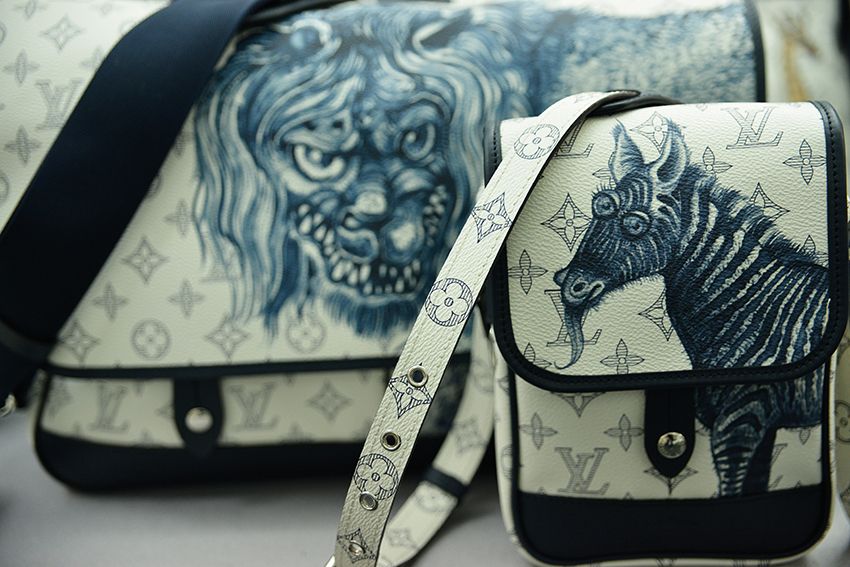
Leather bags bearing animal illustrations by The Chapman Brothers
Indeed, the Sydney pop-up store is designed specifically for the collection it is housing. The brand’s spring/summer 2017 offerings are especially distinctive as a result of a collaboration (actually the second time) with the enfant terrible of British pop art: Jake and Dinos Chapman aka The Chapman Brothers. The result is a series of illustrations featuring quirky (bordering on bizarre) interpretations of some of Africa’s most iconic fauna. Think elephants, rhinos, giraffes, zebras and lions with bulging eyes or sharp teeth (usually both) plastered on T-shirts, leather bags and various accessories.
“Looking at Africa, there’s what people on safari call the big five, which are the lion, leopard, rhino, buffalo and elephant,” Jones explains about the collection’s menagerie. “But the buffalo and the leopard didn’t turn out okay, so we did the zebra and the giraffe to replace them. We thought they were actually a bit more fun to work with. That was how the collection came about. It’s like reading stories from the Louis Vuitton archives, about travelers who got trunks made to go to Africa and then seeing what they were doing in Africa and taking inspiration like that.”
Despite the punk edge courtesy of The Chapman Brothers’ daring visual style, Jones never really felt the need to present a nihilistic or anti-establishment vibe to appear cool. “For me, when I was doing the spring/summer 2017 collection, it was five years since I’ve been at Vuitton and my first collection was about Kenya and Tanzania, and what it was like for me to grow up there as a kid,” he points out. “And now I was drawing inspiration from what’s happening in South Africa, especially from the kids that are around 25 who have grown up after apartheid. They can actually mix together and they’re creating quite a punky interesting style there. Obviously, it’s 40 years since punk came out, but you know, punk is very mainstream now. It doesn’t stand for what it did stand for. So for me, it was nothing antagonistic about it.”

Actor Nick Robinson with Kim Jones
Much like for the collection he presented in Bangkok earlier this year, Jones was also still concerned with attainability. “You know, the men’s business is doing very well, so I just want to keep on making it grow and making it better and better,” he says after musing about how his visit to Thailand “feels like three years ago.” Then he adds: “It’s my job to do that. When you work in these big brands, that’s what we have to do. You look at what’s happening at all those brands that are doing lovely work, you have to think about what your strengths are, and focus on those.”
Naturally, Jones keeps a close eye on who the brand’s customers are. “There are lots of self-made successful men that really enjoy buying Louis Vuitton to celebrate how hard they work and to enjoy their time,” he elaborates. “I like these events [pop-up stores] because I get the chance to meet a lot of our important customers and speak to them, see what they do and hear about what they love about the brand.” Furthermore, he also pays close attention to how the brand is perceived by younger customers. The millennials, if you will.
“Fashion is quite a young thing, so it’s important to have young people shopping and buying something to understand the brand,” he continues. “And we’re a very expensive brand, so we wanted to be more understood in terms of why things are expensive.” Naturally, he does have an answer to this question: “You know, if you buy something from Vuitton, it’s going to last your whole life.” And to that he adds how he’s observed that “men are more faithful to their things, more so than women.”
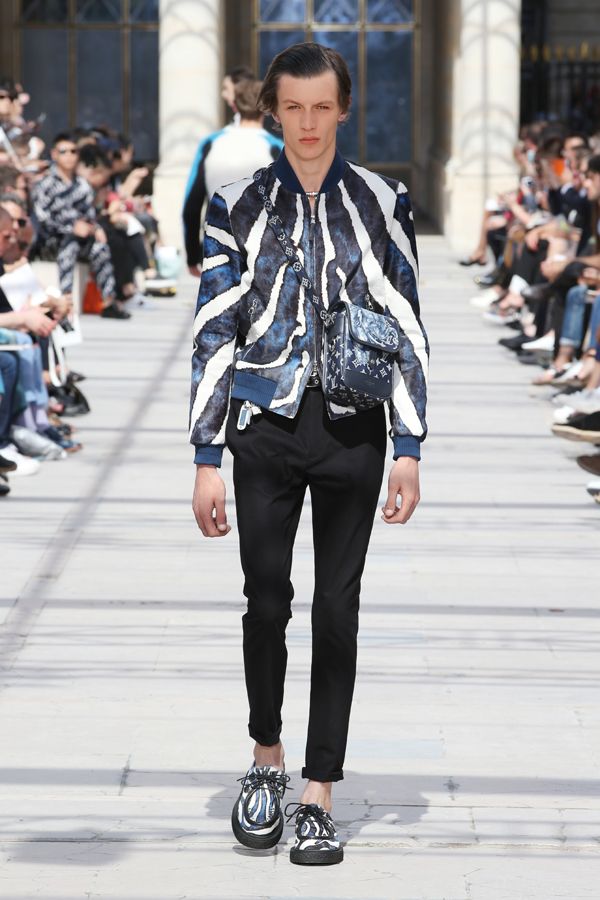
Louis Vuitton’s spring/summer 2017 runway show
All that being said, Jones doesn’t appear to be eager to adopt some of the recent changes in the menswear business, particularly the “see now, buy now” approach. “I’d rather see what happens with that,” he remarks. “I don’t know how sustainable it is. I can understand that as more of a high-street sort of thing. I think for us it’s kind of impossible, because of the quality level that we have to attain. We have probably the highest quality level in the industry, so for us it wouldn’t really be where we want to go.” He’s also not convinced that many people would really want to “run out straight after a show and buy.” People who work in fashion might want to do so, but then again, they obviously are in a position to easily do so. “There are a lot of people who are aspirational customers at Louis Vuitton, and they have to save up the money to buy it. I used to myself, so I know what it’s like,” Jones continues with a chuckle. “It would kill me if the thing came out straight away and I couldn’t afford to buy it. They’re not going to let you pay for it in six monthly installments.”
Collaboration, however, will always be a big part of Kim Jones’ fashion game. For sure, Louis Vuitton himself was always connected to contemporary artists and became a patron for them. “It’s just the legacy of the brand and that’s a great thing to do,” he says about his love of collaborating. “It stops you from getting stale, and it makes you look at things from a different way.”
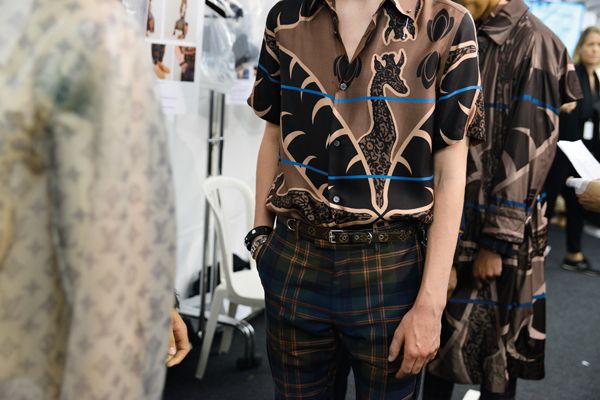
Models backstage wearing the spring/summer 2017 collection
Interestingly, there is one more place where Jones has found a way to look at things from a different way: Instagram. “I find the Explore option on Instagram quite interesting to see pictures that you don’t look at normally,” he shares with obvious delight. “I wouldn’t necessarily say that it influences what I do, but you sort of find interesting people with the same interests. I mean, there are pictures that I’ll screen-grab and put on my mood board. I use it as a visual diary.”
This article first appeared in DA MAN December’16/January’17. Get your copy here.