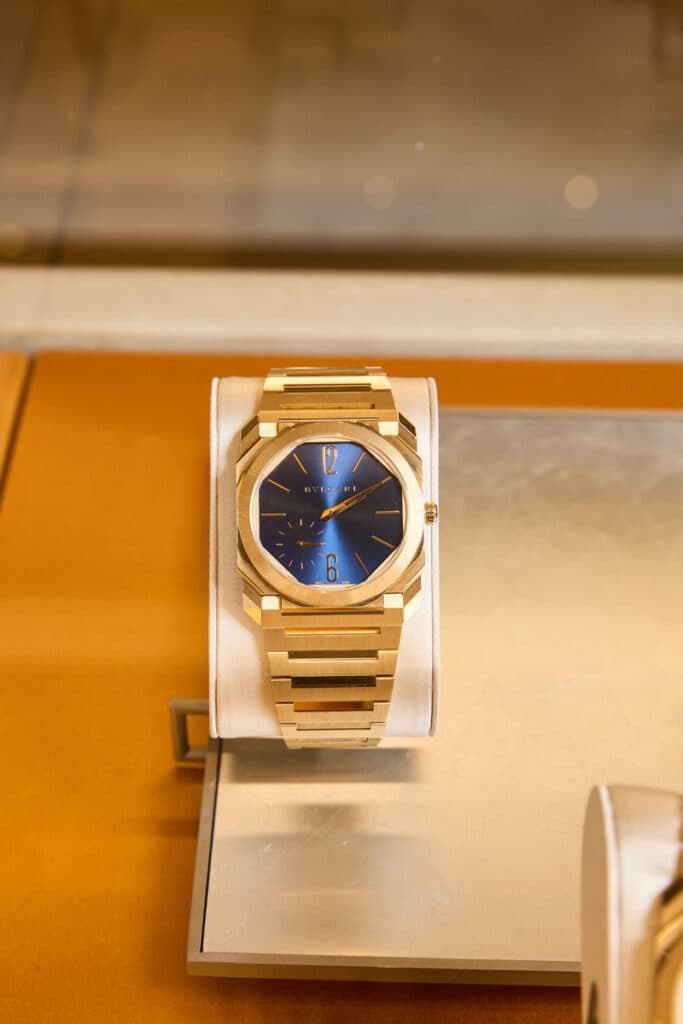


The Octo Finissimo has spent more than a decade pushing the limits of thinness. Now, Bvlgari Product Creation Executive Director Fabrizio Buonamassa Stigliani is taking the collection in a more versatile direction with a new 37mm case, a new movement and the same appetite for challenging convention.

For Peter Zewet, three millimeters can make all the difference. As a former Editor-at-Large for DAMAN who oversaw countless fashion shoots, including many centered on luxury watches, Zewet understands how a seemingly minor adjustment in proportion can transform an entire object. So when he sat down with Fabrizio Buonamassa Stigliani, Bvlgari’s Product Creation Executive Director for watches, over an intimate dinner at Côte by Mauro Colagreco in Bangkok, the conversation about the new Octo Finissimo 37 naturally began with design.
Introduced for 2026, the Octo Finissimo 37 represents a new direction for one of Bvlgari’s most recognizable watch families. Since its debut in 2014, the Octo Finissimo has become synonymous with ultra-thin watchmaking, combining its distinctive octagonal architecture with a succession of record-setting mechanical movements. The new 37 mm interpretation does not replace the established 40 mm model. Instead, it introduces a new set of proportions, a new in-house movement and a more versatile expression of the Octo Finissimo aesthetic.
That makes the reduction in diameter anything but a simple exercise in downsizing. In fact, it required Bvlgari to rethink the watch from the inside out.
“The biggest challenge was to develop a brand-new movement,” Stigliani explains. “Compared with the 40 mm, this is a brand-new watch with a brand-new movement and even more power reserve. The movement is 20 percent smaller in volume, with more power reserve.”
The new self-winding BVF 100 calibre measures just 2.35 mm thick and delivers a 72-hour power reserve. Developed over three years, it shares only its micro-rotor and balance wheel with the previous movement. Everything else, from the mainplate and bridges to the barrel and spring, was redesigned. Even the case, dial and bracelet are new.
For Stigliani, however, the point of all that work is not another entry in Bvlgari’s long list of world records. The 40 mm Octo Finissimo remains the collection’s great technical benchmark, having established records for complications including the minute repeater and perpetual calendar. The 37 mm takes a different direction.
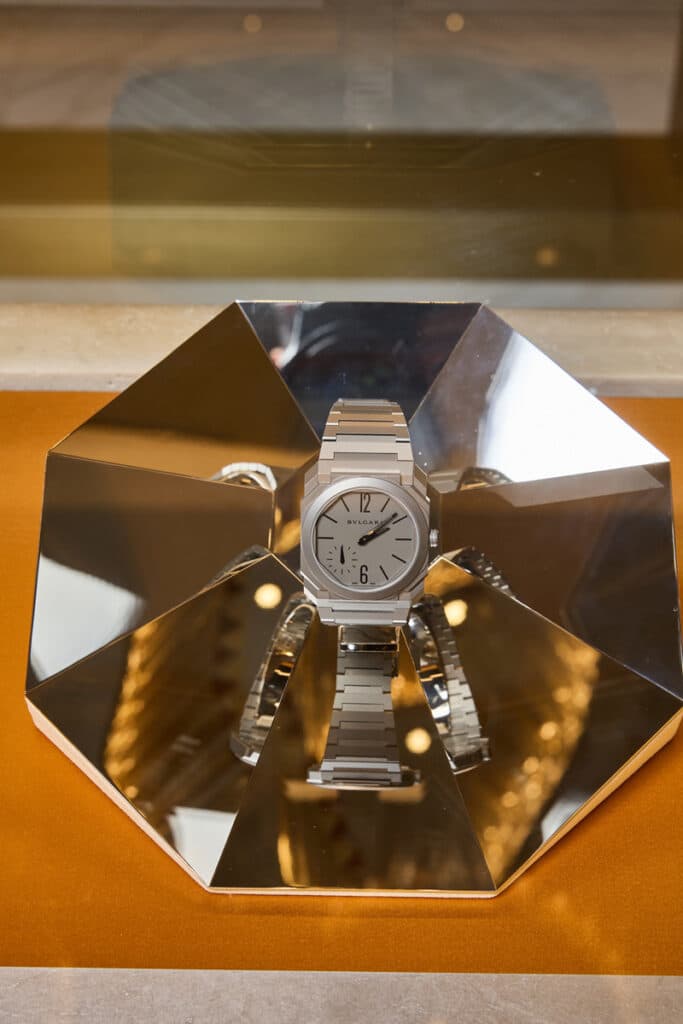
“The 40 mm was the watch of the records,” he says. “We broke so many records: the thinnest mechanical movement in the world, the thinnest minute repeater, the thinnest chronograph, the thinnest perpetual calendar. The 37 mm is not the watch of the record. We have a thicker dial, we have a thicker case and we have a different performance from the movement. It’s the more versatile Octo that we are able to produce.”
That versatility is central to the watch’s appeal. At 37 mm, the new Octo Finissimo is intended to sit more naturally across different wrists and occasions, while the collection’s new titanium and yellow-gold executions allow the same architecture to take on dramatically different personalities. Bvlgari presents four expressions of the 37 mm, including sandblasted and satin-polished titanium, 18-carat yellow gold and a sandblasted-titanium Minute Repeater.
“We were very surprised,” Stigliani says of the discovery. “At the beginning, I thought that the Octo was very segmented as a design and not versatile at all. But we discovered that the watch is very versatile when we started to play with different materials like gold or steel. Each time that we change the finishing and we change the dial, the watch changes completely in attitude.”
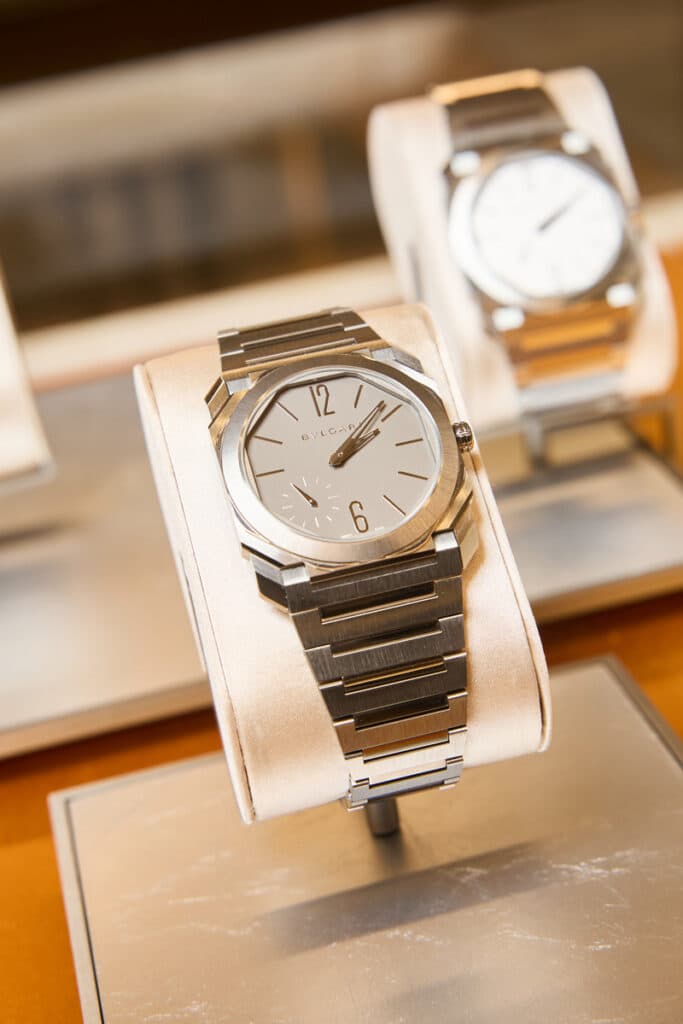
That philosophy has become one of the defining characteristics of the Octo. Sandblasted titanium creates a distinctly contemporary, monochromatic expression, while satin-polished surfaces emphasize the architecture of its many facets. Gold, meanwhile, connects the watch to Bvlgari’s roots as a Roman jewelry house. Stigliani has also experimented throughout the collection with ceramic, carbon, marble and tantalum.
Ask him which one is his favorite, however, and the answer is immediate.
“The next one. Always, always, always the next one.”
It is an appropriately restless response from a designer who sees little value in dwelling on what has already been achieved. Stigliani joined Bvlgari in 2001 after working in automotive design, a background that continues to inform his approach to watchmaking. For him, the attraction of watches was precisely the combination of severe technical constraints and almost limitless creative possibility.
“I was passionate about cars and watches, like a lot of gentlemen,” he says. “And I decided to move to watches because I thought that the world of watches was more free. There are a lot of technical constraints, but it’s a small world. In 40 mm, you can find thousands of components.”
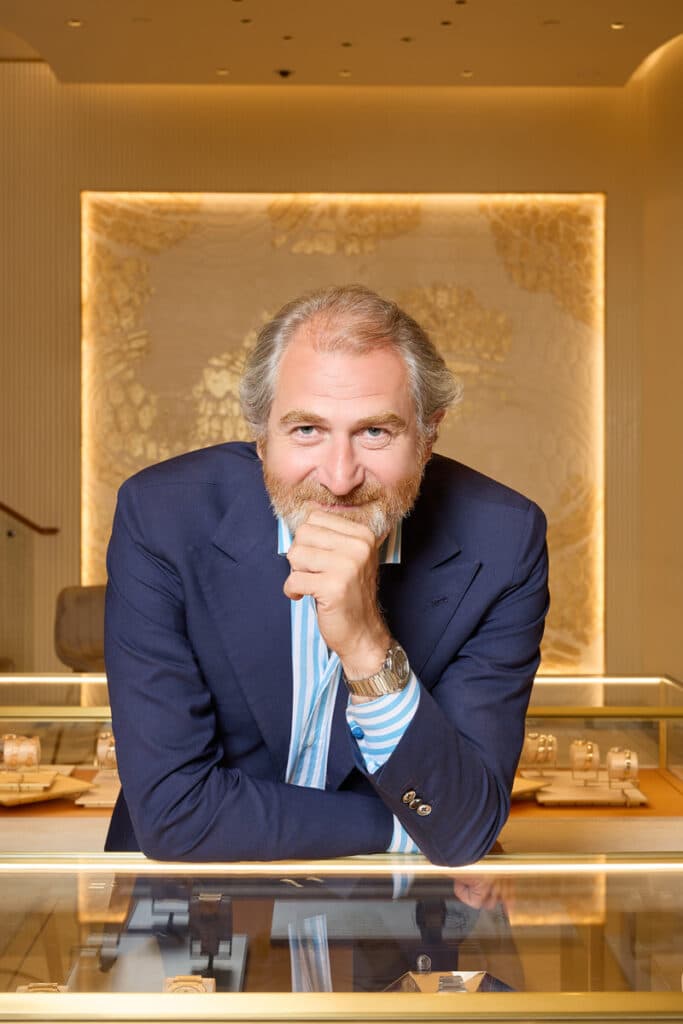
That apparent contradiction, between technical discipline and creative freedom, sits at the heart of his understanding of Bvlgari.
“Mechanics is not enough because it’s so cold, and art is without any constraints, so we have to find a way to put these two elements together,” he explains. “We don’t have a word for design in Italian. It’s an English word. In Italy, we say ‘applied art to industry.’”
The Octo Finissimo embodies that philosophy particularly well. Its technical complexity is deliberately concealed beneath an architectural form that feels remarkably straightforward. It can be worn with tailoring or more casually, and its integrated bracelet reinforces that everyday character.
“This is one of the most complicated watches that you can find on the market, but it looks quite simple,” Stigliani says. “I think this is the Italian attitude.”
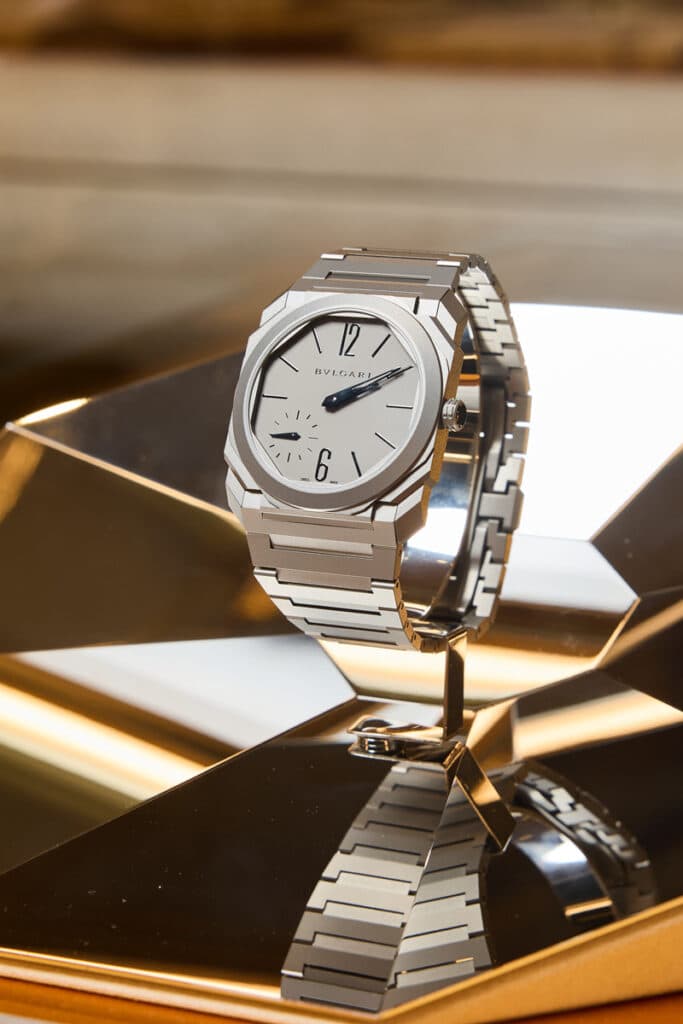
That idea of sophisticated complexity expressed through apparent simplicity also connects naturally with the Italian concept of sprezzatura. Rather than making a show of technical achievement, the Octo Finissimo allows its proportions, surfaces and architecture to do the talking.
The same desire to strip away unnecessary elements informs Stigliani’s own design process. Asked how he balances Bvlgari’s bold Roman identity with the Octo’s minimalist geometry, his answer is remarkably simple: “I try to remove things.”
For Stigliani, restraint is not a shortcut. It is the result of experience.
“I love to remove, because it’s more difficult than adding,” he says. “You arrive at the end of your career, you need to spend all your career adding, just to be able to remove.”
The philosophy extends even to Bvlgari’s most extreme expression of the Octo Finissimo: the 1.85 mm-thick Octo Finissimo Ultra Tourbillon Platinum. Here, the challenge was to combine record-breaking thinness with platinum, a material whose density makes it anything but an obvious choice for ultra-thin watchmaking.
“I can reply in a very Bvlgari way: Why not?” Stigliani says with a laugh. “If it’s a challenge, it’s quite interesting for us. Platinum is the most noble metal alloy. It’s quite dense. It’s quite difficult to work. It’s not exactly what you imagine when you think of an ultra-thin watch. But exactly for that, we are interested in doing it.”
Even the Ultra’s blue accents were the result of painstaking development. Stigliani compares the watch to a Formula One car, where every component has a role in achieving the desired performance.
“Imagine that each single component can improve the performance or can destroy the performance,” he says. “Every single component is dedicated to achieving the result, the aim. If you start to play with decorative elements, it’s not exactly the same objective.”
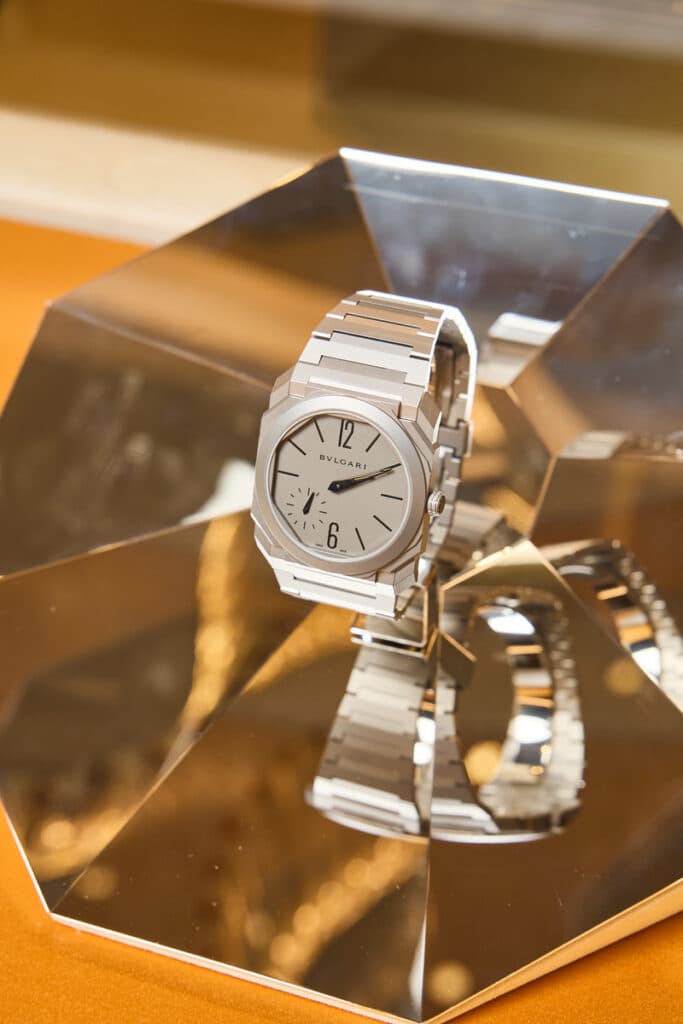
That mindset also explains why Stigliani resists the temptation to chase trends. By the time a new watch reaches the market, years of development have usually passed.
“Honestly, I don’t follow trends anymore,” he says. “Because if you follow trends, you arrive late.”
Instead, Bvlgari’s challenge is to evolve without losing recognition. The 37 mm therefore sits alongside the 40 mm rather than replacing it, adding another expression to an increasingly mature collection.
“We spent 10 years on that, and now we have the 37,” Stigliani says. “It’s not that we changed the aesthetic and the size two years after the launch. The 40 is still on the market. The 37 is going to be different, with stone dials and different executions, because we cannot do those on the 40. So the 37 is going to be another leg on the Finissimo collection.”
It is perhaps the clearest expression of the philosophy behind Bvlgari’s latest Octo Finissimo. After years spent proving how thin, complicated and technically ambitious the collection could become, the next challenge is more subtle: to make all that expertise feel effortless.
For Zewet, it is a familiar lesson from fashion. The most sophisticated silhouettes rarely advertise the amount of work behind them. In the same way, the new Octo Finissimo 37 does not need to announce its engineering credentials at first glance. Its achievement lies in making extraordinary watchmaking look natural.