


CHORUS LINE. All watches show the time, but a minute-repeater will tell you the hours and minutes through chimes and melodic tunes
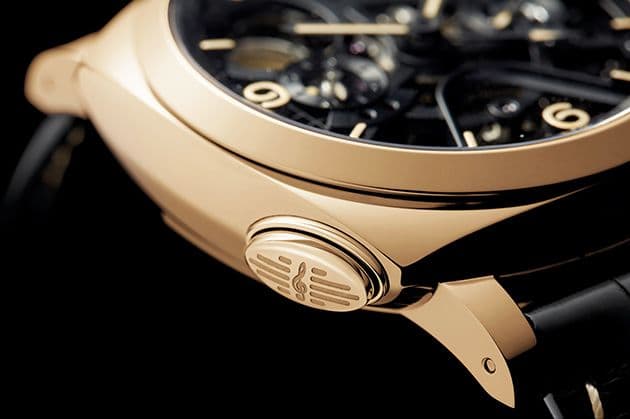
The repeater button on Panerai’s first minute repeater,
the Radiomir 1940 Minute Repeater Carillon Tourbillon GMT
From simple cuckoo clocks at home to iconic clock towers like London’s Big Ben, there’s a timeless charm to timepieces that sound the hours with bells, gongs or the call of a bird. Obviously, we no longer need chiming clocks in this day and age, but it’s still nice to, say, hear an old grandfather clock strike twelve from somewhere deep in the house as you drift off to sleep.
The same principle applies to minute repeater watches—so named because they literally repeat the hours and minutes to you. No, we don’t necessarily need them; the same way we don’t technically need complications such as tourbillons and perpetual calendars. But there’s something inherently appealing to the idea that you can push a button on your watch and have it tell you the time in a series of melodious chimes.
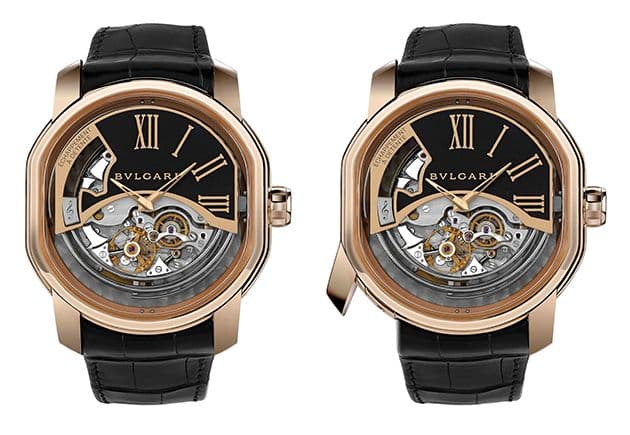
How the repeater lever of the Bulgari L’Ammiraglio del Tempo is operated
The Song of Time
So, what does a minute repeater actually do? Well, a watch with a minute repeater usually comes with an extra button or lever. When the lever is pushed, it triggers a complex mechanism that, in turn, produces a series of tones based on the time.
A typical minute repeater uses three different tones to tell the time: Low (usually verbalized “dong”) for hours, high (“ding”) for minutes and a high-low sequence (“ding-dong”) for quarter hours. At 2:36, for example, the watch would produce two low tones for the hour, two high-low sequences for the two quarter hours and finally six high tones for the remaining six minutes (“dong, dong, ding-dong, ding-dong, ding, ding, ding, ding, ding, ding”).
Minute repeaters are perhaps the most common type of repeater you’ll come across in the world of modern haute horlogerie. Other members of this “family” include hour repeaters that would give you just the hour (so, 2:00 and 2:36 would sound just the same), followed by quarter repeaters that indicate the hour and completed quarter hours (2:30 and 2:36 would give you a “dong, dong, ding, ding” or alternatively “dong, dong, ding-dong, ding-dong”).
Things get a bit more complicated with the half quarter repeater that can sound the time down to half quarters of an hour (which is seven minutes and 30 seconds, to be precise). There would be low tones to indicate the hour, a high-low combo for the quarter hours and then a high tone to indicate whether a half quarter has passed since the last full quarter. Taking our example of 2:36, a watch with a half quarter repeater would give two low tones, two high-low combos to indicate two full quarters and then stop. Push the lever at 2:40, however, and there’ll be an additional high tone since more than half a quarter has passed since the last full quarter.
A lot simpler to figure out are the five-minute repeaters and decimal or ten-minute repeaters, which chime to indicate the hour and how many five or ten minute sections have passed. Furthermore, we also have very specialized types, such as the dumb repeater which vibrates instead of producing an audible sound—quite useful for people who are hearing- or sight-impaired.
The real divas who can sing the most beautiful songs of time, however, are the carillons: Repeaters with three or more gongs and/or hammers. A good example of this type would be the Bulgari Daniel Roth Carillon Tourbillon Minute-Repeater. The skeletonized construction of this watch gives us a clear view of two of its hammers, and upon closer inspection you can notice a third. What’s most interesting about this repeater, though, is that while it uses the usual high and low tones to sound off the hour and minutes, it uses all three notes (E-D-C, for the musically curious) to count the quarters. To further demonstrate the difference that additional gongs and hammers can do, Bulgari has also created the L’Ammiraglio del Tempo. Featuring a full Carillon Westminster-style minute repeater with four hammers, this watch chimes the famous tune of Big Ben. And if that doesn’t sound impressive enough, Bulgari managed to fit a tourbillon into the case.
The wire gongs on one of Piaget’s minute repeaters
The Means of Repetition
The workings of some complex complications like, say, the tourbillon, can actually be summarized quite neatly (“the escapement and balance wheel are placed in a rotating cage”), but alas, such is not the case with the minute repeater. So, please bear with us as we take a closer look.
Interestingly, repeater watches are actually older than tourbillons. The first patent for a repeater watch design was submitted in the 1680s (about a decade after the first repeating clock was invented and over a century before the tourbillon) by two prominent watchmakers, Edward Barlow (a priest, who also invented the aforementioned repeating clock) and Daniel Quare. The matter was resolved in 1687 by the council of King James II of England who favored Quare’s design as it only required the push of a single button to repeat the hour and quarter hours.
In hindsight, royal intervention in this case doesn’t seem like such an overreaction when we consider how popular pocket watches with repeaters became among the nobility. Interestingly, dumb repeaters were particularly favored by members of the aristocracy. These allowed them to discretely check the time in church (where openly looking at a watch would be a major faux pas) or in royal court in front of the country’s monarch (where openly looking at a watch would be a dangerous faux pas).
The next major improvements to repeaters were the addition of an independent set of springs to power the repeater and the replacement of bulky bells with thin wire gongs (this was pioneered by Abraham Louis-Breguet, inventor of the tourbillon).
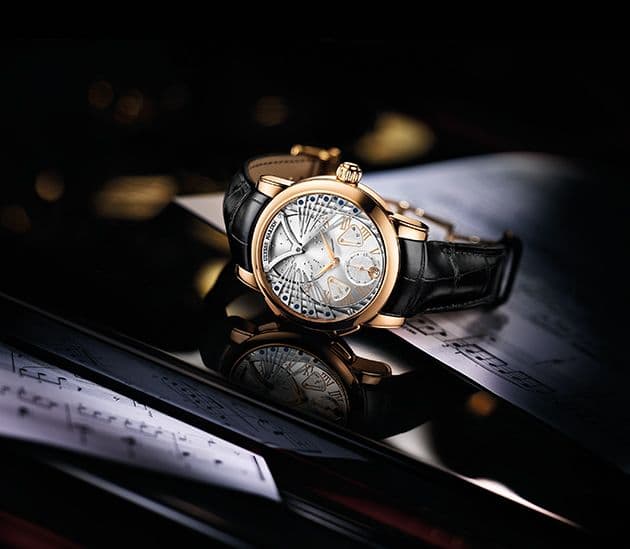
Ulysse Nardin’s Stranger
And now comes the parts that regulate how those gongs are struck. The process of creating the chimes to tell the time is called rack striking, and this process, in turn, relies on a mechanism called a “rack and snail.” The snail refers to a cam shaped like a snail’s shell that will rotate following the hour and minute wheels. A minute repeater would have three snails: One that turns with the hour hand and has 12 different settings; two that turn with the minute hand, one with four settings for the quarter hours and one with 15 for the remaining minutes.
The rack, meanwhile, is a lever that will move toward the snail when the repeater mechanism is triggered. The diameter of the snail-shaped snail, by the way, is at its longest at the 1 o’clock position and shortest at 12. Conversely, the space available for the rack to move is the smallest at 1 o’clock and becomes progressively wider during the later hours. How far the rack can move (how many times the teeth of the rack triggers the chiming mechanism) determines how many chimes you hear.
Members of the Choir
As complex as all this may sound, we’ve only just scratched the surface of how minute-repeaters are brought to life. There’s the immense challenge of fitting the aforementioned mechanism into a watchcase that already houses a movement and other complications; then there’s the manual tuning of the gongs and so on. Perhaps we can imagine top-quality minute-repeater watches as award-winning singers with multiple Grammy Awards.
One such “singer” is the Emperador Coussin Automatic Minute Repeater, Piaget’s first ever repeater watch which boasts a total of 11 major complications. Even with so many mechanisms plus a gong designed to transmit its vibrations (and thereby its sound) through the movement and case, this watch is still incredibly thin. Speaking of which, while we’ve already mentioned the Bulgari Daniel Roth Carillon Tourbillon Minute-Repeater, the Bulgari Octo Finissimo Minute Repeater is no less intriguing as it is currently the smallest and thinnest striking watch in the world. On the other end of the spectrum, we have the Panerai Radiomir 1940 Minute Repeater Carillon Tourbillon GMT that fits two minute repeaters in one case.
There are plenty of innovations in the sound department, too. From Audemars Piguet, for instance, we have the Royal Oak Concept Supersonnerie, which comes with a dedicated “sound board.” This separation of acoustical from technical creates a series of chimes that’s not only louder than just about any minute repeater on the market but also cleaner. Ulysse Nardin, meanwhile, took a couple of notes from classical music boxes for the Stranger, which chimes to the melody of Frank Sinatra’s “Strangers in the Night.” Viewing the mechanism in action through the case-back is also a delight.

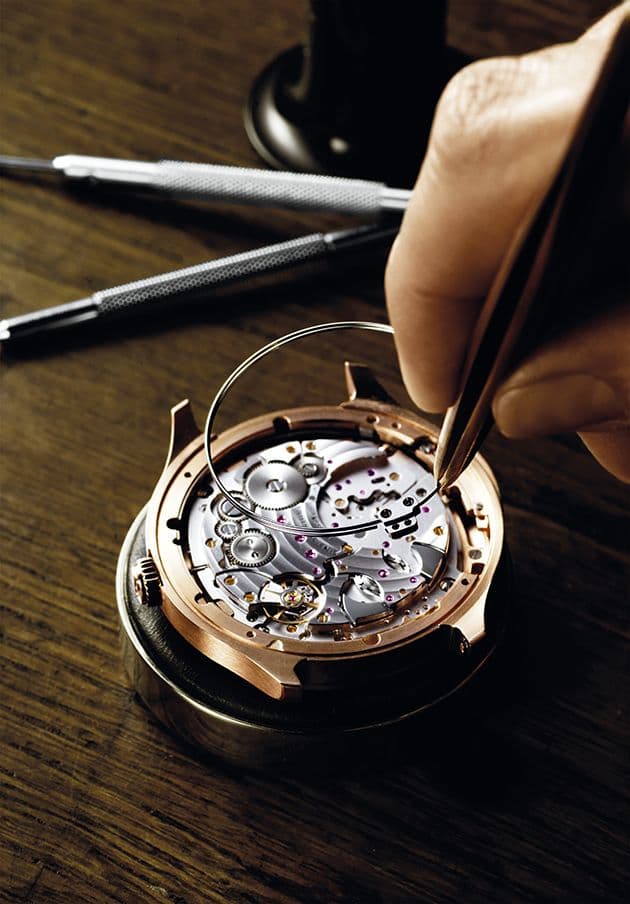
A watchmaker working on a Panerai movement
Closing Notes
To a lord in 17th-century Europe, a repeating pocket watch is a genuinely useful tool. See, trying to discern something as small as the hands and indexes on the dial of a pocket watch in the middle of the night under nothing but candlelight is not exactly easy. Today, with the ubiquity of digital displays, luminous dials and plenty of lighting, we don’t really need a chiming watch.
Then again, fine watches aren’t made merely as tools of timekeeping, and most complications have long outlived their usefulness. Instead, they are pieces of art—desired for their exclusivity, admired for their intricacy and appreciated for the intricate workmanship that went into them. And a purely mechanical watch that can sing out the time at the press of a button certainly has all three of those qualities.